
Korean Eye Patches: 4 Picks From 77 Cents to $4.68 a Pair
Disclosure: some links in this article are affiliate links. If you buy through them we may earn a small commission at no extra cost to you.
An eye patch is a concentrated dose of the same actives in an eye cream, sealed under a hydrogel or fabric layer so they absorb instead of evaporating. That occlusion is the whole mechanism: a patch is not a different ingredient category from a cream, it is a stronger delivery method for fifteen to twenty minutes.
Korean eye patches lean on hydrogel far more than the cotton or fabric versions common elsewhere, and pack in peptides, collagen, PDRN and niacinamide at concentrations a leave-on cream would struggle to hold without irritating the eye area. Our main Korean eye cream ranking covers the leave-on side of eye care; this is the fifteen-minute treatment side.
This is that ranking: four eye patches checked against their actual ingredient lists and current US prices, not just the brand’s own marketing claims.
Key Takeaways
- Four Korean hydrogel eye patches checked against published ingredient lists and current US retail prices, from a five-peptide everyday pack to a premium PDRN treatment mask.
- Cost per pair ranges from 77 cents (COSRX) to $4.68 (Centellian24), a roughly six-times spread driven by pack size and positioning, not just ingredients.
- Dermatological commentary describes a patch as functioning like an eye cream with a stronger delivery method, not a separate treatment category.
- All four are hydrogel format, the dominant Korean eye patch construction; cotton and fabric versions trade some absorption for better essence retention and a lower price.
The 4 best Korean eye patches at a glance
- Best for everyday use: COSRX The Peptide Collagen Hydrogel Eye Patch (around $23 for 30 pairs)
- Best for active-ingredient density: Medicube PDRN Pink Caffeine Collagen Eye Patch (around $24.90 for 30 pairs)
- Best for collagen concentration: Abib Collagen Eye Patch Jericho Rose Jelly (around $25.35 for 30 pairs)
- Best for occasional treatment: Centellian24 360° Shot PDRN Glowing Eye Patch (around $4.68 per pair)
How did we choose these?
Same method as every ranking on this site: published ingredient lists and current US prices from each brand’s own store or a named major retailer, checked against independent commentary and dermatologist perspective on how eye patches actually work. We did not test any of these on skin.
We started from patches that publish a real ingredient list rather than only marketing copy, confirmed fragrance-free status where the brand states it, and looked for genuine differences in format, active-ingredient focus and pack economics instead of four versions of the same product.
What do Korean eye patches cost?
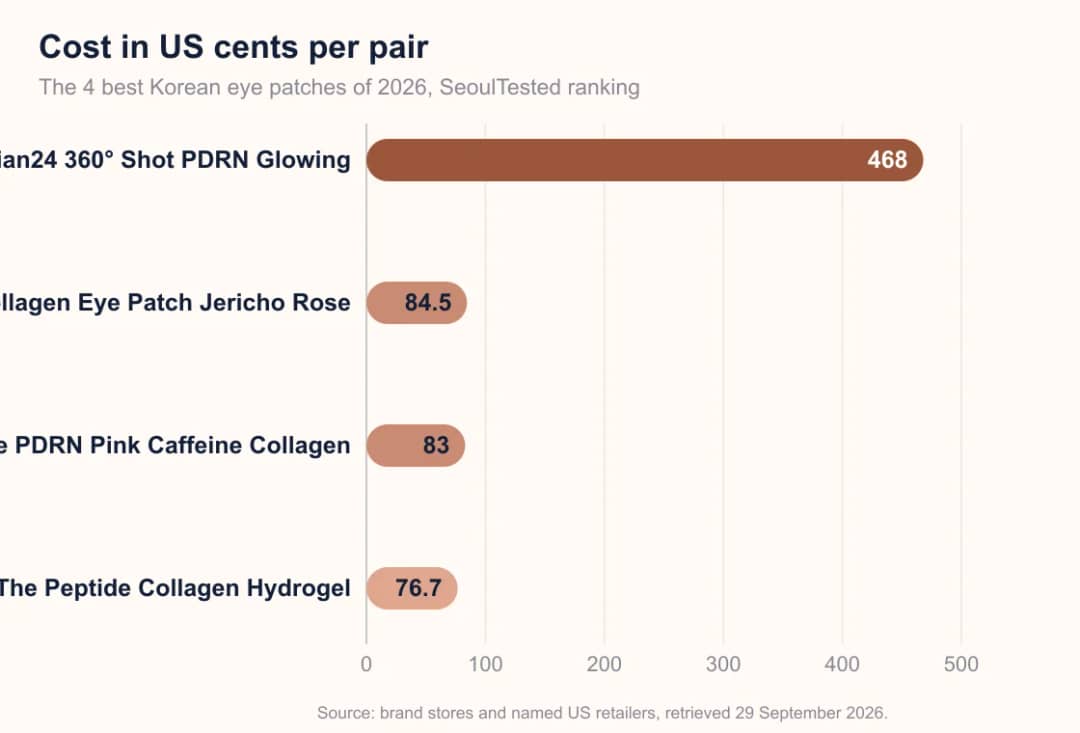
Prices here span from $23 to $25.35 for a 30-pair jar, except Centellian24, which is sold as a treatment-format product at roughly $4.68 per pair instead of a daily-use jar. Cost per pair is the fairer comparison across such different pack sizes.
| Product | Best for | Price | Cost per pair |
|---|---|---|---|
| COSRX The Peptide Collagen Hydrogel Eye Patch | Everyday use | $23 / 30 pairs | 76.7 cents |
| Medicube PDRN Pink Caffeine Collagen Eye Patch | Active-ingredient density | $24.90 / 30 pairs | 83.0 cents |
| Abib Collagen Eye Patch Jericho Rose Jelly | Collagen concentration | $25.35 / 30 pairs | 84.5 cents |
| Centellian24 360° Shot PDRN Glowing Eye Patch | Occasional treatment | $4.68 / pair | $4.68 |
1COSRX The Peptide Collagen Hydrogel Eye Patch: Best for Everyday Use
An independent ingredient breakdown confirms this formula is fragrance and essential-oil-free, built around five peptide types including acetyl hexapeptide-8 and SH-Polypeptide-121, paired with collagen at position 17 on the ingredient list and a full hyaluronic acid stack lower down.
At 76.7 cents per pair, it is the cheapest of the four by a real margin, the everyday option in a category where the other three either cost more per pair or come in a smaller treatment-style pack. The five-peptide, collagen-plus-hyaluronic-acid combination is dense for the price, which is likely why COSRX’s eye care line shows up across multiple budget-pick roundups rather than just one.
Best for: Daily use for anyone building eye patches into a regular routine. Price: $23 for 30 pairs from Ulta.
2Medicube PDRN Pink Caffeine Collagen Eye Patch: Best for Active-Ingredient Density
Medicube’s own product page builds this formula around PDRN, caffeine, retinol and collagen together, a denser combination of actives than the other three picks here take on at once, alongside niacinamide and centella asiatica extract further down the ingredient list.
Caffeine constricts blood vessels, which dermatologists say helps with the puffiness side of the equation specifically, while the retinol and PDRN pairing targets firmness over a longer stretch of use. At 83.0 cents per pair, it sits in the middle of the three everyday-jar picks, priced closer to Abib than to COSRX, with the densest active-ingredient combination of the three.
Best for: Anyone who wants puffiness, firmness and brightening addressed in one patch rather than picking a single focus. Price: $24.90 for 30 pairs from Medicube’s own US site.
3Abib Collagen Eye Patch Jericho Rose Jelly: Best for Collagen Concentration
An independent ingredient breakdown confirms this formula is fragrance and essential-oil-free, with collagen extract at position 10 on the ingredient list, earlier than COSRX’s position 17, alongside sedum sarmentosum extract and a sodium hyaluronate and hydrolyzed hyaluronic acid pairing.
“Jericho Rose Jelly” is the product’s name, not an ingredient; despite the branding, there is no Jericho rose or related botanical extract anywhere on the actual ingredient list. At 84.5 cents per pair, it is the most expensive of the three everyday-jar picks, a premium that buys an earlier collagen position rather than a longer active-ingredient list overall, on paper at least.
Best for: Shoppers who want collagen positioned high on the ingredient list instead of buried near the bottom. Price: $25.35 for 30 pairs (60 patches) from YesStyle.
4Centellian24 360° Shot PDRN Glowing Eye Patch: Best for Occasional Treatment
This formula pairs PDRN with niacinamide, centella asiatica extract and a low-dose retinol, sold not as a daily-use jar but as a treatment-format product soaked with more essence per patch than the other three picks here carry. The brand markets it as a five-times-essence formula built for an occasional deep treatment instead of nightly rotation.
At $4.68 per pair, it costs roughly six times COSRX’s per-pair price, a gap that reflects positioning as much as ingredients. This is the pick for a pre-event treatment or a once-or-twice-a-week addition, not a jar meant to replace daily eye cream in an ordinary routine.
Best for: An occasional, essence-heavy treatment rather than an everyday habit. Price: $4.68 for one pair from YesStyle, with 5-pair and 10-pair bundles available.
Hydrogel or cotton, does the eye patch format matter?
Korean eye patches lean almost entirely hydrogel, and all four picks here are hydrogel, but the format is not the only option on the market and the difference is not cosmetic. Hydrogel forms a tighter occlusive seal over the under-eye area, which pushes more of the essence into skin instead of letting it evaporate into the air, and it delivers that dose faster, typically fifteen minutes versus longer for a fabric patch.
Cotton or pulp-based patches trade some of that absorption speed for better grip and essence retention: they adhere more securely and hold more liquid without sliding, where an oversaturated hydrogel patch can slip out of place mid-treatment. Neither format is objectively better, the choice is between faster delivery and steadier placement, and Korean brands have mostly settled on hydrogel because the format suits a short, high-intensity treatment better than an all-day wear pattern.
Why does PDRN show up in so many Korean eye patches now?
Two of the four picks here, Medicube and Centellian24, list PDRN (polydeoxyribonucleotide, labeled sodium DNA on the ingredient list) as a headline active. It is not a new ingredient, but it is the fastest-growing one in Korean skincare right now: the keyword tracking its serum format alone grew from roughly 9,900 searches a month to 27,100 over the past year.
Brands market PDRN on repair and regeneration language, and it is genuinely derived from salmon DNA, but that marketing framing is the brand’s claim, not a medical one this site makes. What is verifiable is that it shows up alongside niacinamide and retinol rather than replacing them, so a PDRN patch is layering an additional active onto a familiar base, not swapping out the ingredients that were already doing work.
How do you pick the right Korean eye patches for you?
Start with how you actually plan to use them. Daily rotation into a routine points toward COSRX or Medicube, both priced for regular use. An occasional treatment before an event points toward Centellian24’s denser, pricier format instead.
Eye care sits inside the broader Korean moisturizer ranking rather than its own category, since eye cream and eye patches both branch off the same barrier-repair and brightening actives a good moisturizer already covers. Eye patches are one of the last steps in a Korean skincare routine, layered after serum and before a heavier night cream.
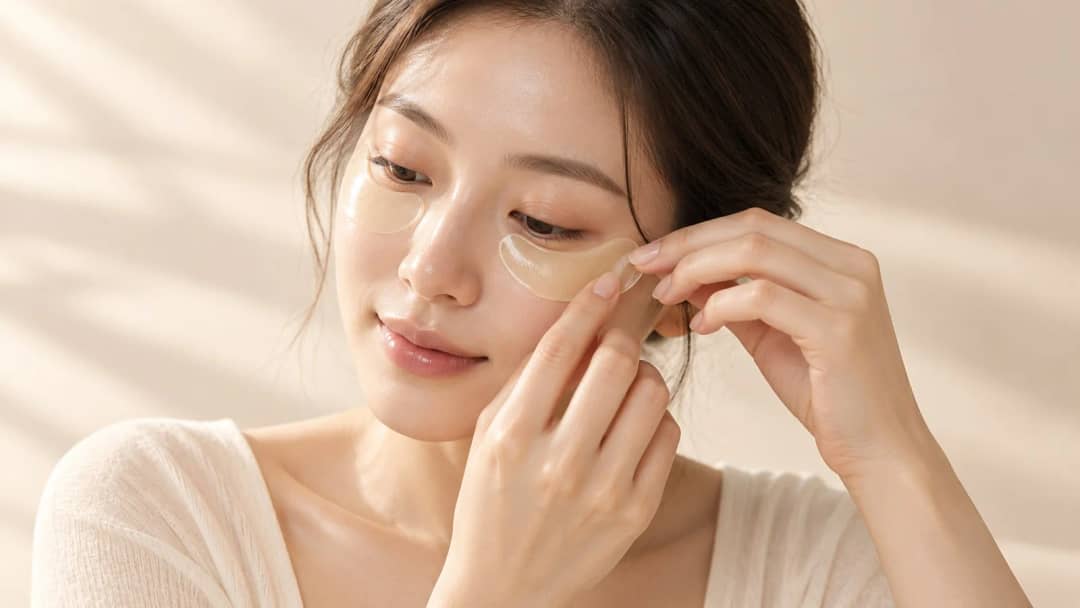
One caveat: an eye patch is a temporary, cosmetic refresh, not a fix for eye bags or genetic dark circles. Dermatologists are consistent on this point, a patch hydrates and can reduce puffiness for a few hours, it does not permanently remove either.
Frequently asked questions
Do Korean eye patches actually work?
Yes, for what they are designed to do. Dermatological commentary describes a patch as delivering an active ingredient under occlusion, essentially a stronger-delivery eye cream. They hydrate and can reduce puffiness temporarily, not permanently, so treat them as a refresh rather than a fix.
Does caffeine in eye patches actually reduce puffiness?
It helps, but it is not the only path there. Caffeine constricts blood vessels, which dermatologists say reduces puffiness. Hydration and the occlusive seal itself also do real work, so a caffeine-free patch is not necessarily a weaker choice for the same purpose.
Why are Korean eye patches almost always hydrogel instead of cotton?
Hydrogel creates a tighter occlusive seal, pushing more essence into skin faster, often within fifteen minutes. Cotton and fabric patches hold more liquid and grip better without sliding, but deliver it more slowly. Korean brands favor hydrogel for quick, concentrated treatments.
Are eye patches a replacement for eye cream?
No. A patch is a concentrated, occasional treatment, not a twice-daily habit. Most routines use a leave-on eye cream every day and add patches a few times a week, or before an event, for the stronger, faster-absorbing dose a patch delivers.
Why is Centellian24 so much more expensive per pair than the other three?
Partly the smaller pack format, sold per pair instead of a 30-pair jar, and partly the five-times-essence formula it is built around. It is priced and positioned as an occasional treatment mask, not a daily-use product, so the per-pair cost reflects that difference in use case.
The bottom line
Buy COSRX’s Peptide Collagen Hydrogel Eye Patch at $23 for 30 pairs if you want the cheapest everyday option. Go Medicube’s PDRN Pink Caffeine Collagen Eye Patch at $24.90 if you want puffiness, firmness and brightening addressed together, Abib’s Jericho Rose Jelly at $25.35 if collagen position on the label matters most to you, or Centellian24’s 360° Shot at $4.68 a pair for an occasional treatment rather than daily use.
Sources
- INKEEDecoder, “COSRX The Peptide Collagen Hydrogel Eye Patch” ingredient breakdown, 5-peptide formula and fragrance-free confirmation, retrieved 29 September 2026, inkeedecoder.com
- Ulta, “COSRX The Peptide Collagen Hydrogel Eye Patch” listing, $23/30 pairs regular price, retrieved 29 September 2026, ulta.com
- Medicube, “PDRN Caffeine Collagen Eye Patch” product page, ingredient list and $24.90 regular price, retrieved 29 September 2026, medicube.us
- INKEEDecoder, “Abib Collagen Eye Patch Jericho Rose Jelly” ingredient breakdown, collagen position and fragrance-free confirmation, retrieved 29 September 2026, inkeedecoder.com
- YesStyle, “Abib Collagen Eye Patch” listing, $25.35/60 patches (30 pairs) regular price, retrieved 29 September 2026, yesstyle.com
- YesStyle, “Centellian24 360° Shot PDRN Glowing Eye Patch” listing, $4.68 regular price per pair, retrieved 29 September 2026, yesstyle.com
- Patchology, “Are Under Eye Patches Worth the Hype?”, dermatologist-sourced commentary on the occlusion mechanism and caffeine’s role in reducing puffiness, retrieved 29 September 2026, patchology.com