
Korean Skincare Routine for Oily Skin: Changes, Myths and Timing
Disclosure: some links in this article are affiliate links. If you buy through them we may earn a small commission at no extra cost to you.
Short answer: the Korean skincare routine itself does not change shape for oily skin. The order of steps stays the same. What changes is which products fill three of those steps, and how often one of them gets used.
About 90 people in the US search this exact phrase every month, a modest but real and steadily rising number. Most of what they find online repeats the same generic 10-step list regardless of skin type, which is not much help if your skin is already producing plenty of its own oil by noon.
This guide covers the process, not a product ranking: what to keep from the general Korean skincare routine, what to swap, and where “oily skin” advice online tends to overcorrect into something dermatology sources do not actually support.
Key takeaways
- The routine order does not change for oily skin. Cleanse, treat, moisturize, protect stays the sequence; only product texture and frequency shift.
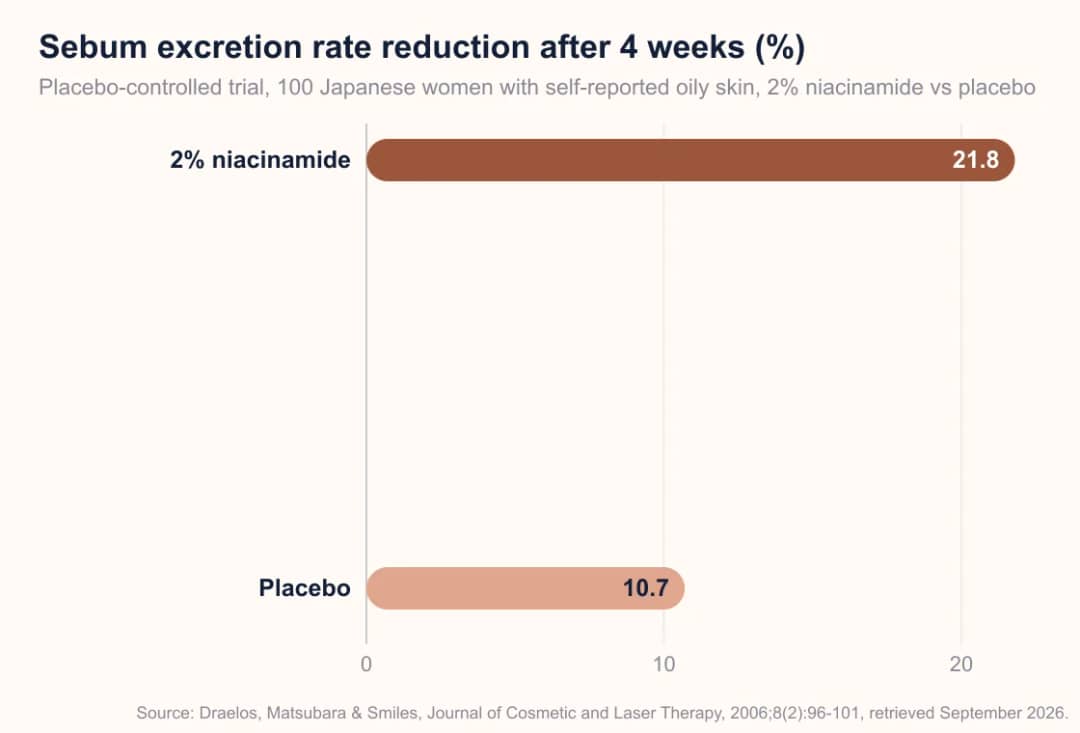
- A placebo-controlled trial of 100 Japanese women with self-reported oily skin found 2% niacinamide reduced sebum excretion by 21.8% after 4 weeks, against 10.7% for placebo.
- A board-certified dermatologist recommends starting a BHA like salicylic acid at one to three times a week, not daily, even for oily and acne-prone skin.
- Skipping moisturizer because skin is oily is a myth dermatology sources consistently argue against: under-moisturized skin can prompt more oil, not less.
- Double cleansing is the routine’s default, not an oily-skin-specific add-on. A Cleveland Clinic dermatologist notes it is not necessary for most people and can trigger breakouts on acne-prone skin if the oil step is wrong for that skin.
The Korean skincare routine for oily skin at a glance
- Cleansing: keep the double cleanse if you wear sunscreen or makeup, but pick the oil-based first step carefully. Read the label rather than defaulting to any oil cleanser.
- Toner or essence: lightweight, hydrating formula as usual, but lean toward one with niacinamide or a mild BHA rather than pure hydrators.
- Exfoliation (BHA): salicylic acid stays useful here more than for other skin types, but frequency still starts low, one to three times weekly, not daily.
- Moisturizer: non-negotiable step. Texture moves from cream to gel or gel-cream, not away from moisturizer entirely.
- Sunscreen: same daily step, matte or mattifying finish instead of a dewy or glow-forward one.
How did we put this together?
Same method as every guide on this site: dermatology publishers, a peer-reviewed sebum study, ingredient databases, and aggregated commentary from people who actually deal with oily skin day to day. We did not test any routine on skin ourselves.
The medical sources here are the American Academy of Dermatology’s own public guidance pages, Cleveland Clinic, and two named, board-certified dermatologists writing under their own bylines, not an anonymous “expert says” attribution. The sebum figures come from a placebo-controlled clinical study published in a peer-reviewed journal, not a brand’s own marketing claim. Ingredient specifics are checked against INKEEDecoder’s independent database rather than taken from a product label alone.
The starting point was our own general Korean skincare routine pillar, which already covers the standard morning and evening sequence step by step. This guide only exists to answer one narrower question: what changes when the skin underneath that routine is oily.
Our How We Review page covers this methodology in full.
Cleansing: the double cleanse question
Double cleansing, an oil cleanser followed by a water-based one, is already the routine’s evening default, not something oily skin needs to add on top. What’s less clear is whether it still makes sense once skin is already producing extra oil.
Cleveland Clinic dermatologist Dr. Jane Wu is more skeptical of the practice than most K-beauty content is. She states plainly that “double cleansing is usually not necessary” and that “for most people, washing your face once thoroughly with a gentle cleanser is more than adequate,” warning that overwashing can dry out skin and break down its barrier.
The same source flags a risk for acne-prone skin: an oil cleanser can trigger breakouts, especially used alone rather than with a second cleanse. Check a cleansing oil’s ingredient list rather than skip or add the step out of habit.
Practically: keep the double cleanse on sunscreen or makeup days, choose a lighter, non-comedogenic oil cleanser over a heavy one, and use a gentle foaming cleanser on bare-skin days.
Toner and essence: what actually changes here
The hydration-first philosophy behind Korean toner does not change for oily skin. Dermatologist Jane Yoo makes the point directly: Korean toners are built to restore pH and deliver hydration after cleansing, not to strip oil the way a Western astringent does.
What changes is the ingredient inside that same lightweight, water-based format. For oily or congestion-prone skin, Yoo recommends lightweight formulas built around niacinamide or a mild BHA, used in moderation rather than daily at full strength.
Stripping oil at this step tends to backfire for the same reason a moisturizer cannot be skipped later: skin reacting to dehydration by producing more oil, not less. A toner built to hydrate first and treat second works with that mechanism instead of against it, the actual argument for keeping the format the same even as the active ingredient changes.
That is the swap worth making in a toner pick for oily skin: same texture and same place in the sequence, different active ingredient doing the work.
The case for (and against) heavier BHA use
Salicylic acid is oil-soluble, which is exactly why it earns a bigger role in an oily-skin routine than it does elsewhere. The INKEEDecoder ingredient database describes it as lipid soluble, able to travel into the pore itself rather than sitting on the surface, and names it one of the standard ingredients for oily or “problem” skin at concentrations of roughly 0.5 to 2 percent.
That does not mean daily use is the goal. Board-certified dermatologist Dr. Donna Hart recommends using a BHA like salicylic acid one to three times a week and avoiding pairing it with a retinoid on the same night, regardless of how oily the skin is.
The realistic version for this routine: start at one to two nights a week, watch for the flaking, stinging or sudden breakouts that mark over-exfoliation, and only add a third night once skin has tolerated the lower frequency for several weeks.
Moisturizer texture: gel or gel-cream, not skipped

The single biggest thing that changes in this routine for oily skin is texture, not the step itself. A gel or gel-cream moisturizer, built on water and humectants like hyaluronic acid rather than heavier oils, is the standard swap in place of a richer cream.
The step is not optional. The American Academy of Dermatology’s guidance on acne-prone skin states that “when your skin becomes dry, your body makes more oil,” and recommends applying moisturizer daily, looking for one labeled oil-free and non-comedogenic.
Its separate guidance on oily skin specifically repeats the instruction to apply moisturizer after cleansing rather than treating oily skin as an exception to that step.
The label to look for matters more than the price. “Oil-free” and “non-comedogenic” describe how a formula is built, not how expensive it is, and both terms show up on inexpensive gel moisturizers as often as costly ones. Texture is the only real swap; the daily habit of applying it does not change.
Sunscreen finish: matte instead of dewy
Sunscreen does not move, get skipped, or become optional for oily skin. What changes is finish: a matte or mattifying formula instead of the dewy, glow-forward finish that suits drier skin better.
The step matters more, not less, once a BHA is in the routine. Salicylic acid works by removing surface skin cells, the same layer sunscreen protects; a few BHA nights a week is not the moment to get lax about the last AM step.
A dewy or glow-forward finish sits on top of a texture oily skin already produces on its own, the mismatch that shows up as breakthrough shine by midday. A mattifying finish sits flatter against that same oil instead of adding to it.
We cover the mechanism and five specific picks built for that finish in our dedicated ranking of Korean sunscreens for oily skin, including which filter types tend to sit clearer on oil-prone skin and which still risk a visible cast.
Why “skip moisturizer if you’re oily” is a myth
This advice keeps circulating because it sounds logical: skin is already oily, so why add more moisture. Dermatology sources argue the mechanism runs the other way.
The American Academy of Dermatology’s position, cited above, is that dehydrated skin can respond by producing more oil, not less, which can work against the goal of controlling shine in the first place.
That mechanism is also why the BHA guidance earlier lands on one to three times a week rather than daily. Over-exfoliating and then skipping moisturizer compounds the same problem twice: both push skin toward the oil production dermatologists are trying to prevent, not the shine-free result the person is actually after.
The fix is not removing the step. It is picking a lighter, oil-free, non-comedogenic formula so hydration does not come bundled with extra oil the skin does not need, and keeping it in the routine daily rather than reaching for it only when skin already feels dry or tight.
Should you spot-treat blemishes separately?
The instinct to dab treatment only on an active blemish feels efficient, but it works against the routine rather than for it.
The American Academy of Dermatology lists this as a habit to stop, naming it a mistake to “apply acne medication only to your blemishes”, since treating only what is visible fails to stop new breakouts forming underneath.
Its actual guidance is to spread a thin layer of medication across all acne-prone skin, not just active spots. That is one more reason this routine needs no extra step: the BHA already covers the acne-prone zone, so a separate spot product would duplicate it while leaving the rest under-treated.
Layering a benzoyl peroxide spot treatment on top of the toner and BHA already in this routine raises the same problem in miniature: two products doing similar work on the same patch of skin, adding irritation risk without a real benefit over applying the existing BHA step properly across the whole area.
How long before you see a difference?
None of these swaps work overnight, and expecting them to is the fastest way to abandon a change that was actually working.
The American Academy of Dermatology’s general guidance is that a working treatment shows some improvement in 4 to 6 weeks, with fuller clearing taking two to three months or longer. That lines up with the niacinamide study above, which measured its sebum reduction at the 4-week mark, not sooner.
The practical read: give a new toner or BHA frequency at least a month before judging it, and avoid stacking a new toner, a new BHA schedule and a new moisturizer in the same week. Changing one variable at a time is the only way to know which swap actually helped.
The niacinamide, BHA and AAD timelines above all land in the same rough window: something is either working within four to six weeks, or it needs a different approach entirely rather than more patience.
What actually changes vs the general routine
The pillar routine already walks through the standard morning and evening sequence step by step. Here is specifically where oily skin diverges from that default, and where it does not.
| Step | Stays the same | Changes for oily skin |
|---|---|---|
| Cleansing | Double cleanse on makeup or sunscreen days | Lighter, non-comedogenic oil step; single wash on bare-skin days |
| Toner or essence | Lightweight, hydration-first formula, same place in sequence | Niacinamide or mild BHA replaces pure hydrating actives |
| Exfoliation | Still starts low and builds slowly | Ceiling can move higher, up to roughly 3x weekly for BHA specifically |
| Moisturizer | Still a required daily step, both AM and PM | Texture: gel or gel-cream instead of a heavier cream |
| Sunscreen | Still daily, still the last AM step | Finish: matte or mattifying instead of dewy or glow-forward |
Frequently asked questions
Do I still need to moisturize if I have oily skin?
Yes. The American Academy of Dermatology recommends applying moisturizer daily even for acne-prone and oily skin, choosing an oil-free, non-comedogenic formula rather than skipping the step. Dehydrated skin can respond by producing more oil, which works against the goal of reducing shine.
How often should oily skin use a BHA like salicylic acid?
Board-certified dermatologist Dr. Donna Hart recommends starting at one to three times a week rather than daily, and avoiding pairing it with a retinoid on the same night. Oily and acne-prone skin often tolerates BHA well, but that is a reason to build up gradually, not a reason to start at daily use.
Is double cleansing necessary for oily skin specifically?
Not inherently. Cleveland Clinic dermatologist Dr. Jane Wu says double cleansing is not necessary for most people and that washing once thoroughly is usually enough. It remains useful on days you wear sunscreen or makeup, but oily skin does not need it more than any other skin type does.
What is the best moisturizer texture for oily skin in a Korean routine?
A gel or gel-cream texture built on water and humectants like hyaluronic acid, rather than a heavier cream built on oils and emulsifiers. The step itself does not change, only the texture and the “oil-free, non-comedogenic” label to look for.
Does niacinamide actually reduce oil, or is that marketing?
A 2006 placebo-controlled study of 100 Japanese women with self-reported oily skin found that 2% niacinamide reduced sebum excretion rate by 21.8% after 4 weeks, against 10.7% in the placebo group. A separate arm of the same study in 30 Caucasian subjects found a smaller, less consistent effect, so results can vary by skin.
The bottom line
The Korean skincare routine does not need extra steps for oily skin, and it does not need fewer either. It needs the same five steps with three swaps: a lighter cleansing oil where relevant, a BHA-forward toner used one to three times a week rather than daily, and a gel moisturizer under a matte sunscreen.
The two habits worth dropping are skipping moisturizer and assuming more frequent acid use is automatically better. Both run against what dermatology sources actually recommend, even for skin that makes plenty of its own oil.
Start from the general routine, make the five swaps above, and adjust exfoliation frequency slowly based on how skin responds, not on a fixed schedule.
Sources
- American Academy of Dermatology, “Moisturizer: Why you may need it if you have acne”, retrieved September 2026, aad.org
- American Academy of Dermatology, “How to control oily skin”, retrieved September 2026, aad.org
- American Academy of Dermatology, “10 skin care habits that can worsen acne”, retrieved September 2026, aad.org
- American Academy of Dermatology, “9 things to try when acne won’t clear”, retrieved September 2026, aad.org
- Draelos ZD, Matsubara A, Smiles K, “The effect of 2% niacinamide on facial sebum production”, Journal of Cosmetic and Laser Therapy, 2006;8(2):96-101, retrieved September 2026, tandfonline.com
- Jane Yoo, MD, “What Korean Toner Actually Does (It’s Not Astringent)”, retrieved September 2026, janeyoomd.com
- Dr. Donna Hart, MD, Westlake Dermatology, “Over-Exfoliation: Warning Signs, Causes, and Prevention”, retrieved September 2026, westlakedermatology.com
- Cleveland Clinic, “Double Cleansing Method Explained: Should You Try It?”, Dr. Jane Wu, retrieved September 2026, health.clevelandclinic.org
- INKEEDecoder, “Niacinamide (Explained + Products)”, ingredient database, retrieved September 2026, inkeedecoder.com
- INKEEDecoder, “Salicylic Acid (Explained + Products)”, ingredient database, retrieved September 2026, inkeedecoder.com