
Essence vs Serum: Where the Ingredient Order Actually Changes
Disclosure: some links in this article are affiliate links. If you buy through them we may earn a small commission at no extra cost to you.
Essence and serum are the two steps people assume must be different because one costs more. Both are liquids applied after cleansing. Both promise to do something a moisturizer alone will not.
The toner and essence sold under those two names turned out to barely differ in our last comparison. Essence and serum do not tell the same story. This time the ingredient order shows a real split, and it is worth seeing why.
So we read the ingredient lists again. One Korean product sold as an essence, one sold as a serum.
Key takeaways
- Neither word has a regulatory definition, the same rule that applied to toner and essence. What differs here is what the labels actually contain.
- The serum in our comparison lists its active extract before water. The essence lists a water-adjacent ingredient first. That is not typical, and it is a real difference in formulation, not marketing.
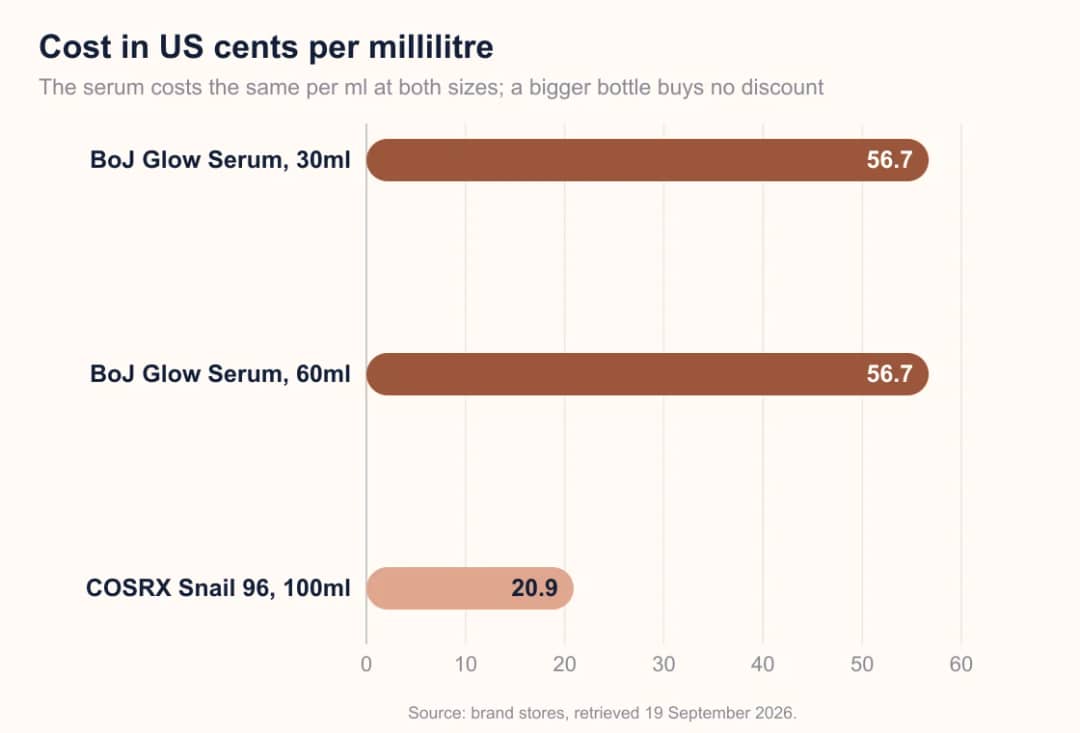
- The serum costs 56.7 cents per millilitre. The essence costs 20.9. The serum is 2.7 times the price per millilitre.
- Buying the serum in a larger size does not change that: 30ml and 60ml work out to the identical 56.7 cents, unlike the toner we priced last time, where a bigger bottle cut the cost by 43%.
- A 2000 paper in Experimental Dermatology gives a physical limit on what either product can deliver: molecules over about 500 Daltons do not cross intact skin, whatever the label says.
What is the difference between an essence and a serum?
In practice, a serum usually costs more and is marketed as more concentrated. An essence usually costs less and is marketed as lighter and more about hydration. Neither claim is enforced by anyone.
Reading the ingredient lists showed this pair splits more than toner and essence did. The serum we priced lists its main active ahead of water. The essence lists a functional ingredient first too, but at a fraction of the serum’s price.
So the category word is still not proof of anything on its own. But this time, checking the ingredient list confirms the marketing instead of contradicting it.
Independent sources describe the same texture split without our price data: essences are consistently described as thin and water-like, serums as thicker or gel-like, with the serum carrying the higher concentration of a named active.
How did we put this together?
We do not test products on skin. This piece is built from published ingredient lists, US labelling rules, a peer-reviewed pharmacology paper on skin penetration, and prices collected from each brand’s own store in September 2026.
For the ingredient comparison we used COSRX Advanced Snail 96 Mucin Power Essence, already checked in our toner and essence piece, against Beauty of Joseon’s Glow Serum, one of the more established Korean serums sold in the US. Both are widely stocked and both publish a full INCI list.
Prices are the brand’s own listed price at the sizes stated, not a discounted or promotional price, for the same reason we corrected a price in the last post: a sale price is not what the product costs.
Beauty of Joseon’s own store currently shows both a regular and a sale price side by side. We used the regular one, and checked it against the 60ml size to see whether the two agreed.
Do the words essence and serum mean anything on a label?
No, not by law. The same rule that applies to toner and essence applies here: the FDA classifies a cosmetic by its intended use, not by the word a company puts on the front of the bottle. There is no approved list of formats a brand must choose from.
A brand selling a thin, cheap liquid has a reason to call it an essence. A brand selling a concentrated, expensive one has a reason to call it a serum. Neither choice is checked by anyone before the product ships.
What is checked, because a law requires it and no marketing team decides it, is the order the ingredients appear in.
A claim on the back of a bottle can be verified in thirty seconds. A claim on the front, resting on nothing but a more expensive-sounding word, can only be taken on faith.
What do the two ingredient lists actually show?
They show a real split this time, not an overlap. The essence carries 12 ingredients. The serum carries 30. That alone does not prove much, since ingredient count did not predict formula strength in our toner comparison either.
| Product | What the box calls it | Ingredients | First ingredient | Active concentration stated |
|---|---|---|---|---|
| COSRX Advanced Snail 96 Mucin Power Essence | Essence | 12 | Snail secretion filtrate | Not stated on the label |
| Beauty of Joseon Glow Serum: Propolis + Niacinamide | Serum | 30 | Propolis extract | 60% propolis, 2% niacinamide |
What is unusual is the order. US labelling rules require ingredients above 1% to be listed by descending weight, and Beauty of Joseon’s serum lists its named active, propolis extract, ahead of water, which does not appear until position five.
A formula where the marketed active outweighs water is genuinely uncommon. The brand’s own 60% figure is consistent with that order, not just a number printed on a marketing page.
The essence’s first ingredient, snail secretion filtrate, is also ahead of water, but COSRX does not publish a percentage for it, so there is no equivalent number to check the order against.
Why the serum costs so much more per millilitre
Partly the formulation, and partly the bottle. Per millilitre, the essence runs 20.9 cents and the serum 56.7, so the serum costs 2.7 times as much.
Some of that gap tracks the propolis concentration: 60% of an extract is a larger raw-material cost than an essence whose active sits at an undisclosed, and probably far lower, percentage. Some of it is simply what the word serum is allowed to charge, independent of what is actually inside the bottle.
The size lever that mattered in our toner comparison does not apply here. Beauty of Joseon’s serum costs $17 for 30ml and $34 for 60ml: double the volume, double the price, so buying the larger bottle saves nothing per millilitre.
The Round Lab toner we priced last time behaved differently. Its 500ml bottle cost 43% less per millilitre than the 50ml.
Does a serum actually penetrate deeper than an essence?
Sometimes, not because of the category word. A 2000 paper sets out the 500 Dalton rule: compounds larger than roughly 500 Daltons do not cross intact skin in meaningful amounts (Bos and Meinardi, Experimental Dermatology). Its evidence: essentially all known contact allergens fall under that weight.
That limit applies to a serum exactly as much as an essence. Niacinamide, at roughly 122 Daltons, clears that bar easily, and so do propolis extract’s smaller active compounds.
A large protein or a high molecular weight polymer, in either an essence or a serum, mostly sits on the skin surface regardless of what the label calls it.
So “more concentrated” is a real, checkable claim, provable from the ingredient order and the stated percentage, as it is here. “Penetrates deeper because it is a serum” is not a claim either product’s category can make on its own; it depends on the size of the specific molecule, not the word on the bottle.
Do you need both an essence and a serum?
Usually, yes, if you want what each is actually formulated to do, unlike the toner and essence pair we looked at last time. A hydrating essence and a serum built around a single high-percentage active answer different questions instead of repeating each other.
Where they do overlap is when both are marketed as general “hydration and glow” products with no named active ingredient at a stated percentage. In that case you are likely paying twice for the same job, and the ingredient list, not the category word, is what tells you which situation you are in.
The same question applies one step earlier in the routine, where a hydrating toner and a plain toner pad can also double up on the same job.
For a broader view of where a targeted active fits against a full lineup, our ranking of nine Korean serums covers a wider price and concentration range than the single product compared here.
Which goes first, essence or serum?
Essence first, then serum. That is the conventional order after toner and before moisturizer, and it holds regardless of which is thinner, unlike the toner and essence layering question, which came down to texture instead of the name.
The reasoning is the same as elsewhere in the routine: apply the lighter, more universally tolerated step first, then the more targeted, higher-concentration step once the skin has absorbed the first layer.
Reversing the two does not cause harm. It just means the serum’s active spends longer sitting on top of the essence rather than on the skin.
The same logic decides where a mist or an ampoule would slot in too: thinnest first, thickest last, right up until the moisturizer seals the whole stack in. Our guide to the Korean skincare routine sets out the full order, including where a toner fits before either of them.
Frequently asked questions
Can a serum replace an essence?
Sometimes, but not reliably. If the serum you own already delivers hydration, adding an essence is redundant. If the serum is built around one high-percentage active like the 60% propolis extract here, it is not doing an essence’s hydration-and-prep job, so the two are not substitutes.
Why does the serum cost so much more than the essence?
Partly the raw-material cost of a 60% active extract, and partly what the category word is allowed to charge. In our comparison the serum ran 56.7 cents per millilitre against 20.9 for the essence, 2.7 times as much.
Does a bigger bottle make a serum cheaper per millilitre?
Not always. Beauty of Joseon’s Glow Serum costs $17 for 30ml and $34 for 60ml, so the price simply doubles with the size and the larger bottle saves nothing. Some toners behave differently, where a bigger size lowered the cost noticeably.
Do serums really penetrate deeper into skin?
Depends on the molecule, not the category. Research on skin penetration puts a rough ceiling around 500 Daltons for a compound to cross intact skin at all. Ingredients under that weight can penetrate whether they are sold in an essence or a serum, and ones above it mostly cannot either way.
How can I tell if a serum’s active percentage is real?
Check where it sits in the ingredient list. US rules require ingredients above 1% to be listed in descending order, so a 60% active has to appear near the top, ahead of water, the way propolis extract does here. A claim that lists the same ingredient near the bottom would not add up.
The bottom line
Essence and serum are still unregulated category words, exactly like toner and essence. What is different this time is that checking the ingredient order confirmed the price gap instead of undermining it.
A serum whose named active sits ahead of water at a disclosed 60% is a genuinely different formula from an essence that does not publish a percentage at all.
The lesson carries across both comparisons even though the verdicts differ. The category word never tells you what you are buying. The ingredient list, read in the order the law requires, always does.
That is the one test worth running before any purchase, whichever of these four words is printed on the front: toner, essence, serum, or something newer the marketing team invents next year.
For what goes on after either one, see our ranking of Korean moisturizers, or browse everything in serums.
Sources
- US Food and Drug Administration, “FDA Authority Over Cosmetics: How Cosmetics Are Not FDA-Approved, but Are FDA-Regulated”, retrieved 19 September 2026, fda.gov
- US Food and Drug Administration, “Summary of Cosmetics Labeling Requirements”, 21 CFR 701.3(f), retrieved 19 September 2026, fda.gov
- Bos JD, Meinardi MM, “The 500 Dalton Rule for the Skin Penetration of Chemical Compounds and Drugs”, Experimental Dermatology, 2000, volume 9, pages 165 to 169, PMID 10839713, retrieved 19 September 2026, pubmed.ncbi.nlm.nih.gov
- INKEEDecoder, “COSRX Advanced Snail 96 Mucin Power Essence ingredients”, retrieved 19 September 2026, inkeedecoder.com
- INKEEDecoder, “Beauty of Joseon Glow Serum: Propolis + Niacinamide ingredients”, retrieved 19 September 2026, inkeedecoder.com
- Ulta Beauty, “COSRX Advanced Snail 96 Mucin Power Essence 3.38 oz” listing price, retrieved 19 September 2026, ulta.com
- Beauty of Joseon, official store, “Glow Serum: Propolis + Niacinamide” product page, 30ml and 60ml listed prices, retrieved 19 September 2026, beautyofjoseon.com