
Toner vs Essence: What the Ingredient Lists Actually Show
Disclosure: some links in this article are affiliate links. If you buy through them we may earn a small commission at no extra cost to you.
Toner and essence are the two steps people add to a routine without being sure why. Both are thin liquids. Both go on after cleansing. Both are sold as though the other one cannot replace them.
Almost every page that answers this question is published by a brand that sells both products. That is not a reason to distrust them, but it is a reason to check the claim against something a brand cannot edit.
So we read the ingredient lists. Four Korean products, two sold as toners, one as an essence, one that calls itself both on the same bottle.
Key takeaways
- Neither word has a regulatory definition. The US Food and Drug Administration classifies a cosmetic by what it is intended to do and what it claims, not by the category name on the front of the box.
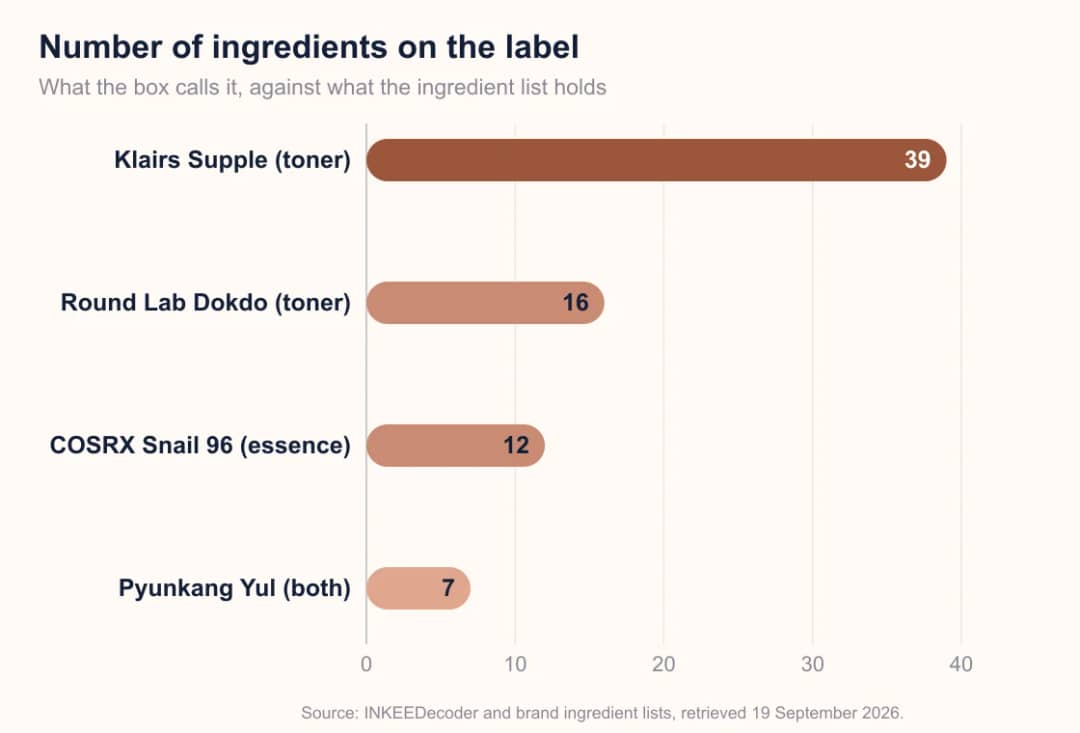
- The label does not predict the formula. A product sold as a toner carried 39 ingredients; one sold as an essence carried 12. The shortest list of the four, at 7 ingredients, belonged to a product calling itself an essence toner.
- Ingredient order is the part worth reading. US rules require ingredients above 1% to be listed in descending order, so the first three names tell you more than the category ever will.
- Both toners here led with water. Both essences led with a functional ingredient instead. That is a real pattern, and it is the only one we found.
- The same toner costs 12.0 cents per millilitre in a 50ml bottle and 6.8 in a 500ml bottle, a 43% gap on identical liquid.
What is the difference between a toner and an essence?
In practice, an essence is usually the more concentrated of the two and a toner is usually the more watery. Neither word is defined by anyone except the brand printing it.
A toner is traditionally applied after cleansing on a cotton pad. An essence is traditionally patted in with the hands, and sits between the toner and the serum.
Those are conventions, not rules. Of the four Korean products compared below, the one with the longest ingredient list, at 39, is sold as a toner. The one with the shortest, at 7, is sold as an essence toner.
The clearest difference is not in the name at all. Both products labelled toner open with water, while both labelled essence open with a functional ingredient instead.
A more useful question is which formula you need, and the back of the bottle answers that one.
How did we put this together?
We do not test products on skin. This piece is built from published ingredient lists, US labelling rules, dermatology research, and prices collected from brand stores and US retailers in September 2026.
For the ingredient comparison we chose four Korean products that are widely sold in the United States and sit in a similar price band, so the difference between them would not simply be budget. Every list below was read from the published INCI declaration, not from marketing copy.
Two of the four are sold as toners, one as an essence, and one carries both words. We picked that fourth deliberately, because a product using both names at once is the clearest test of whether either word constrains a formula.
Prices are list prices at the sizes stated, taken from the brand’s own store where it sells directly and from a US retailer otherwise. Where a claim comes from a brand that sells the product, we have said so.
Do the words toner and essence mean anything on a label?
No. Neither term carries a legal definition in the United States. The Food and Drug Administration classifies a product as a cosmetic by its intended use, meaning what it is marketed to do. The category word a company picks for the front of the box has no bearing on that.
There is no approved list of product types that a brand must pick from, and cosmetics do not require FDA approval before they go on sale.
So the words toner, essence, ampoule, booster and treatment water are positioning decisions. A brand that wants to charge more for a thin liquid has a commercial reason to call it an essence, and a brand that wants to sell a routine has a reason to sell you two bottles instead of one.
Which is why this article compares formulas. The category is the one part of the packaging with no rules behind it.
What do four real ingredient lists show?
They show that the category name predicts almost nothing about what is inside. Of the four products below, the longest ingredient list belongs to a toner and the shortest belongs to a product that calls itself an essence toner.
| Product | What the box calls it | Ingredients | First ingredient | Price per ml |
|---|---|---|---|---|
| Klairs Supple Preparation Facial Toner | Toner | 39 | Water | not compared |
| Round Lab 1025 Dokdo Toner | Toner | 16 | Water | 8.5 cents (200ml) |
| COSRX Advanced Snail 96 Mucin Power Essence | Essence | 12 | Snail secretion filtrate | 20.9 cents (100ml) |
| Pyunkang Yul Essence Toner | Both | 7 | Astragalus root extract | 10.0 cents (200ml) |
A 39 ingredient toner and a 7 ingredient essence toner are not variations on one idea. They are different products wearing overlapping names.
The spread runs from 7 ingredients to 39, close to a sixfold range. The two products furthest apart on it both carry the word toner on the label, one alone and one alongside essence, which is the clearest sign that the word is not describing the formula.
The Klairs formula also carries six essential oils, including lemon peel, lavender and orange peel oil, which matters to anyone shopping for a fragrance-free routine. None of the other three contains them. Nothing in the word toner would have warned you either way.
Why the order of an ingredient list is the part worth reading
Because the order is regulated even though the category name is not. US labelling rules require cosmetic ingredients to be declared in descending order of predominance, with two exceptions: colour additives, and anything present at one percent or less, which may be listed in any order (21 CFR 701.3(f)).
That rule turns the back of the bottle into usable information. Whatever sits in the first three or four positions is the bulk of what you are buying. Anything listed after the preservatives and thickeners is usually present in fractions of a percent.
Read that way, the four products split along a line the marketing never mentions. Both toners open with water. Both essences open with something else: snail secretion filtrate in one, astragalus root extract in the other.
This is the one real pattern we found. An essence is more likely to lead with a functional ingredient, which is a reasonable working definition, though it is a tendency and no regulator enforces it.
Does a toner balance your skin’s pH?
Healthy skin maintains its own acidic surface, which is why the claim needs care. A 2025 review calls the acid mantle a buffer system in the upper stratum corneum, central to keeping the barrier intact, and notes that shifts in pH disrupt it (Brooks and colleagues, Journal of Investigative Dermatology).
The word buffer is doing the work. A buffer resists change and returns to its set point, which is why intact skin does not need a second product to restore it.
So the useful advice is narrower than the marketing. If a cleanser leaves skin feeling tight, a gentler cleanser beats a corrective liquid afterwards, which is also the question worth asking about a two step cleanse.
A toner cannot undo a wash that was too harsh, and no product here treats a skin condition.
A hydrating toner or essence earns its place simply: it adds water-binding ingredients to damp skin before you seal them in. That is a cosmetic benefit, and reason enough.
Do you need both a toner and an essence?
For most people, no. Because the categories overlap so heavily, a single well-chosen bottle usually covers what two would. Kiehl’s, which sells both, describes essences as more targeted and more concentrated than toners, which stops short of calling them a necessity.
What your skin does after cleansing settles it better than the labels do. If it feels tight and dry a few minutes later, a more concentrated hydrating layer is the useful purchase, whatever the box calls it. If it feels comfortable already, a second thin liquid buys you texture and little else.
One case for owning both is ingredients that do different jobs: a hydrating layer plus a separate exfoliating product on its own schedule.
Two bottles that both mainly deliver water and humectants are redundant whatever their names. A targeted active is a serum’s job, and we have ranked nine Korean serums from $17 to $89.
Our ranking of Korean toners by skin type covers hydrating and exfoliating options.
When does the label actually tell you something?
When it names a mechanism instead of a category. Exfoliating toner, AHA toner and BHA toner all describe what the product does, and those are genuinely different from a hydrating liquid. So is an acid you would use twice a week instead of twice a day.
The same goes for a first essence or fermented essence, which points to a specific type of ingredient, and for pad formats, where the delivery method changes how much product you use per application. We have priced those separately in our guide to Korean toner pads.
So the test is whether the word on the box tells you what the product does. If it only tells you where the product sits in a routine, as toner and essence both do, you still have to turn the bottle over and read the first few names.
Which goes first if you use both?
Thinner first, then thicker. If you own a toner and an essence and one is visibly more watery, that one goes on first, on skin that is still slightly damp from cleansing, and the more viscous one follows.
Texture decides it, not the label. Tip both onto the back of a hand and the one that runs goes first. The Pyunkang Yul essence toner is described as a gel-type formula, so it would go second against anything watery, despite carrying the word toner on the bottle.
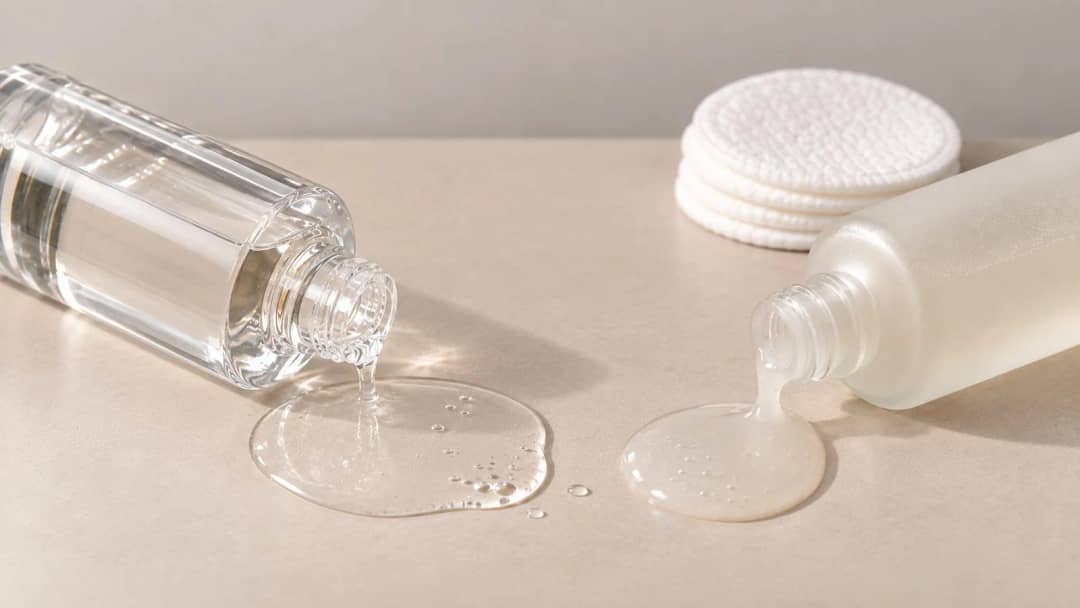
That ordering is a convention, not a research finding. It exists because a thick layer applied first can slow how well a thin one spreads, and nothing breaks if you reverse them.
Where either sits in a full routine is a separate question, and we have mapped the whole sequence in our guide to the Korean skincare routine, including which steps can be dropped.
What does each one cost per millilitre?
Less than the category suggests, and bottle size moves the number more than the label does. The Round Lab toner is sold in four sizes at once, which makes it a clean test.
The identical liquid works out at 12.0 cents per millilitre in the 50ml bottle and 6.8 cents in the 500ml, a difference of 43%.
Across the products we priced, the essence was the dearest per millilitre at 20.9 cents and the plain toner the cheapest at 6.8 in its 500ml size, with the essence toner in between at 10.0.
Compared like for like at 200ml, the plain toner is 8.5 cents and the essence toner 10.0, an 18% gap rather than a dramatic one. Concentration explains the direction, even if the gap is modest.
Size is the lever most people ignore. If you have settled on a product you use daily and it comes in a larger bottle, buying up is usually a bigger saving than switching brands to a cheaper one.
Frequently asked questions
Can an essence replace a toner?
Usually yes. Since neither word has a regulatory definition, an essence can contain everything a hydrating toner does. The exception is an exfoliating toner containing an acid, which does a different job that a hydrating essence will not cover.
Is an essence just an expensive toner?
Not always, but the price gap is real. In our comparison the essence cost 20.9 cents per millilitre against 8.5 for the plain toner in the same 200ml size, roughly two and a half times as much. Whether that is justified depends on the first few ingredients, not on the category.
What is an essence toner?
A product sold under both names at once, which is permitted because neither term is regulated. The Pyunkang Yul version carries 7 ingredients and leads with astragalus root extract rather than water, so in formula terms it behaves more like an essence.
Do toners actually balance skin pH?
Healthy skin buffers its own surface pH. Research describes the acid mantle as a self-regulating buffer system in the upper stratum corneum, so intact skin does not need a product to restore it. A gentler cleanser is the better fix for tightness after washing.
How do I tell a hydrating product from an exfoliating one?
Read the first five ingredients. Hydrating formulas lead with water, glycerin, butylene glycol or a humectant extract. Exfoliating ones name an acid such as glycolic, lactic or salicylic acid, and are meant for use on a schedule instead of every day.
Does a shorter ingredient list mean a better product?
No. It means fewer variables, which helps if you are avoiding fragrance or tracking what your skin reacts to. The 39 ingredient toner in our comparison includes six essential oils; the 7 ingredient one includes none. That difference is worth knowing, though it does not make either product better.
The bottom line
Toner and essence are categories with no rules behind them, and the four products we compared prove how little the words constrain a formula. A toner ran to 39 ingredients and an essence toner to 7.
The one honest generalisation is that essences tend to lead with a functional ingredient while toners tend to lead with water. Even that is a tendency, and the ingredient list settles it in about ten seconds.
Buy the formula, not the category. If your skin feels tight after cleansing, reach for the more concentrated option and check that its first three ingredients are ones you want. If it does not, one bottle is enough, and the money is better spent on the step that follows it.
For what goes on next, see our ranking of Korean moisturizers, or browse everything in toners.
Sources
- US Food and Drug Administration, “FDA Authority Over Cosmetics: How Cosmetics Are Not FDA-Approved, but Are FDA-Regulated”, retrieved 19 September 2026, fda.gov
- US Food and Drug Administration, “Summary of Cosmetics Labeling Requirements”, 21 CFR 701.3(f), retrieved 19 September 2026, fda.gov
- Brooks SG, Mahmoud RH, Lin RR, Fluhr JW, Yosipovitch G, “The Skin Acid Mantle: An Update on Skin pH”, Journal of Investigative Dermatology, 2025, volume 145, pages 509 to 521, PMID 39243251, retrieved 19 September 2026, pubmed.ncbi.nlm.nih.gov
- INKEEDecoder, “Klairs Supple Preparation Facial Toner ingredients”, retrieved 19 September 2026, inkeedecoder.com
- INKEEDecoder, “COSRX Advanced Snail 96 Mucin Power Essence ingredients”, retrieved 19 September 2026, inkeedecoder.com
- INKEEDecoder, “Pyunkang Yul Essence Toner ingredients”, retrieved 19 September 2026, inkeedecoder.com
- Round Lab, “1025 Dokdo Toner” product page, ingredient list and prices for 50ml, 100ml, 200ml and 500ml, retrieved 19 September 2026, roundlab.com
- Ulta Beauty, “COSRX Advanced Snail 96 Mucin Power Essence 3.38 oz” listing price, retrieved 19 September 2026, ulta.com
- Pyunkang Yul, official global store, “Essence Toner” product page, 200ml listing price, retrieved 19 September 2026, pyunkangyulglobal.com
- Kiehl’s, “Essence vs. Toner: How Do These Essentials Differ?”, retrieved 19 September 2026, kiehls.com