

Double Cleansing: What the Evidence Says and Who Can Skip It
Disclosure: some links in this article are affiliate links. If you buy through them we may earn a small commission at no extra cost to you.
Double cleansing is a two step method: an oil based cleanser first, then a water based one. It reached the United States through Korean and Japanese routines, and it is now the default advice on most skincare accounts.
That advice is usually given as though it applies to everyone. The evidence points somewhere narrower. The second step earns its place under specific conditions, and outside those conditions it mostly costs you money.
We priced 26 Korean cleansers by the millilitre for this, and read the research on what each kind of cleanser actually removes.
Key takeaways
- A 2020 study in the Journal of Cosmetic Dermatology found a foaming cleanser left 36.8% of water-resistant sunscreen on the skin, while a cleansing oil left 5.8%.
- On ordinary, non water-resistant sunscreen the same foaming cleanser left 15.6%, which the study found no different from clean skin. The oil step added almost nothing.
- Cleveland Clinic’s position is that double cleansing is “usually not necessary” and that one thorough wash suits most people.
- Across 26 Korean cleansers we priced, balms cost a median of 21.5 cents per millilitre against 10.1 for face washes. Cleansing oils cost 10.5, level with face washes.
- If a double cleanse feels expensive, that is usually the balm rather than the method.
What is double cleansing?
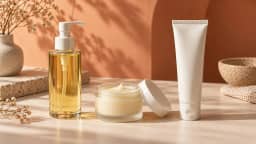
Double cleansing means washing the face twice in one sitting with two different kinds of product. The first is oil based, either a cleansing oil or a cleansing balm. The second is water based, usually a gel or foam face wash.
The logic is chemical rather than ceremonial. Sunscreen filters, silicones and long wear makeup are oil soluble, so an oil based product lifts them. Sweat, dirt and any oily residue left behind then come off with a water based wash.
Anything oil based counts as a first cleanse. A cleansing oil, a cleansing balm, or micellar water all work on the same principle, and the choice between them is about texture and price rather than about what they remove.
Almost every guide presents this as a night time step, and that part is uncontroversial. The open question is whether the second product does enough work to justify buying it.
How did we put this together?
We do not test products on skin. This piece is built from published research, guidance from dermatology bodies, and the prices and ingredient lists we collected for our own cleanser rankings.
The cost figures come from 26 products: nine cleansing oils, eight cleansing balms and nine face washes, each priced from brand stores and US retailer listings in September 2026. Those are the same figures published in the three rankings linked below.
Is double cleansing necessary?
For most people, no, and the measurement shows it more plainly than the advice does. On ordinary sunscreen a single foaming cleanser left 15.6% of residue behind, which the study that measured it found no different from clean skin at 9.9%.
The second step only opens a real gap on water-resistant products. There the same foaming cleanser left 36.8% while a cleansing oil left 5.8%. Necessity depends almost entirely on which of those two situations you are in.
Cleveland Clinic dermatologist Dr Jane Wu reaches the same place clinically: “Double cleansing is usually not necessary. For most people, washing your face once thoroughly with a gentle cleanser is more than adequate” (Cleveland Clinic, published 21 June 2022).
She names waterproof makeup, sunscreen and oily skin as the cases where it helps, and warns that “overwashing can lead to dryness, irritation and the breakdown of the skin barrier, which subsequently causes issues like breakouts and eczema.”
What does the research actually show?
Chen and colleagues photographed 20 participants with a VISIA imaging system before sunscreen, after sunscreen, and after washing, then measured how much remained (Journal of Cosmetic Dermatology, 2020). They tested water alone, a foaming cleanser, and a cleansing oil, on two kinds of sunscreen.
| Sunscreen type | Water only | Foaming cleanser | Cleansing oil | Clean skin baseline |
|---|---|---|---|---|
| Not water-resistant | 54.0% | 15.6% | 13.4% | 9.9% |
| Water-resistant | 59.3% | 36.8% | 5.8% | 3.2% |
On ordinary sunscreen a plain foaming cleanser left 15.6% behind, and the study found no significant difference between that and clean skin. The cleansing oil reached 13.4%, better on paper and not meaningfully better in practice.
Water-resistant sunscreen behaves differently. There the foaming cleanser left 36.8% sitting on the face, while the cleansing oil left 5.8%, again no different from clean skin. That difference is what the oil step is for.
Whether this applies to you depends on the bottle. Water resistance is printed on the front, and among the eleven Korean sunscreens we checked filter lists for, it is common rather than universal.
A result that rarely gets quoted: eight of the 20 participants reported dry skin after the foaming cleanser, against one after the cleansing oil. On the harder job the gentler product also performed better.
How reliable is that study?
It is one study of 20 people, with residue assessed from VISIA photographs rather than chemical analysis. Treat the direction as reliable and the exact percentages as approximate.
The bigger limitation is what it did not test. Each method was used on its own, so nobody compared an oil cleanse followed by a face wash against a face wash alone. The paper tells you what each single step removes. The two step case is inferred from that.
One number circulating online should be retired. Several articles claim double cleansing removes around 96% of residue and attribute it to research of this kind. That figure does not appear in this paper, and we could not find a primary source for it anywhere else.
What is the second cleanse actually removing?
The numbers carry an implication the popular advice skips. In this study the cleansing oil used on its own already reached the clean skin baseline on both sunscreen types, with no second wash after it.
If the oil has already taken the sunscreen off, the second step is doing a different job. It is removing the oil, so that whatever comes next goes onto bare skin rather than onto a film.
That matters most for the watery layers. A toner is mostly water and humectants, and neither gets through an oily residue.
That reframing is reasoning across from a study that did not test the steps in sequence, not a measured finding, and we would rather say so than present it as one. It does explain something the guides never quite justify: why the second product can be completely plain.
How do you double cleanse?
Oil or balm onto a dry face first, worked in for about a minute, emulsified with water and rinsed. Then a water based wash on damp skin for 30 to 60 seconds. The whole thing takes two or three minutes.

Step 1: the oil cleanse
- Apply the oil or balm to a dry face with dry hands. Water stops it binding to the makeup and sunscreen.
- Work it in for about a minute, concentrating on the hairline, the sides of the nose and the jaw, where sunscreen collects.
- Wet your hands and keep massaging until the product turns milky, then rinse. Skipping this leaves a film.
Step 2: the water cleanse
- Apply the face wash to damp skin, leaving the face wet from the rinse.
- Wash for roughly 30 to 60 seconds to clear anything the first step left behind.
- Rinse with lukewarm water and pat dry rather than rubbing.
The American Academy of Dermatology advises lukewarm water, a gentle non-abrasive cleanser, and fingertips rather than a cloth or sponge, on the grounds that anything else irritates the skin (AAD, Face washing 101).
The AAD also advises limiting washing to twice a day and after sweating. A night time double cleanse sits inside that, since it is one cleansing session. Adding a second double cleanse in the morning is where people drift past the advice.
What does a double cleanse cost?
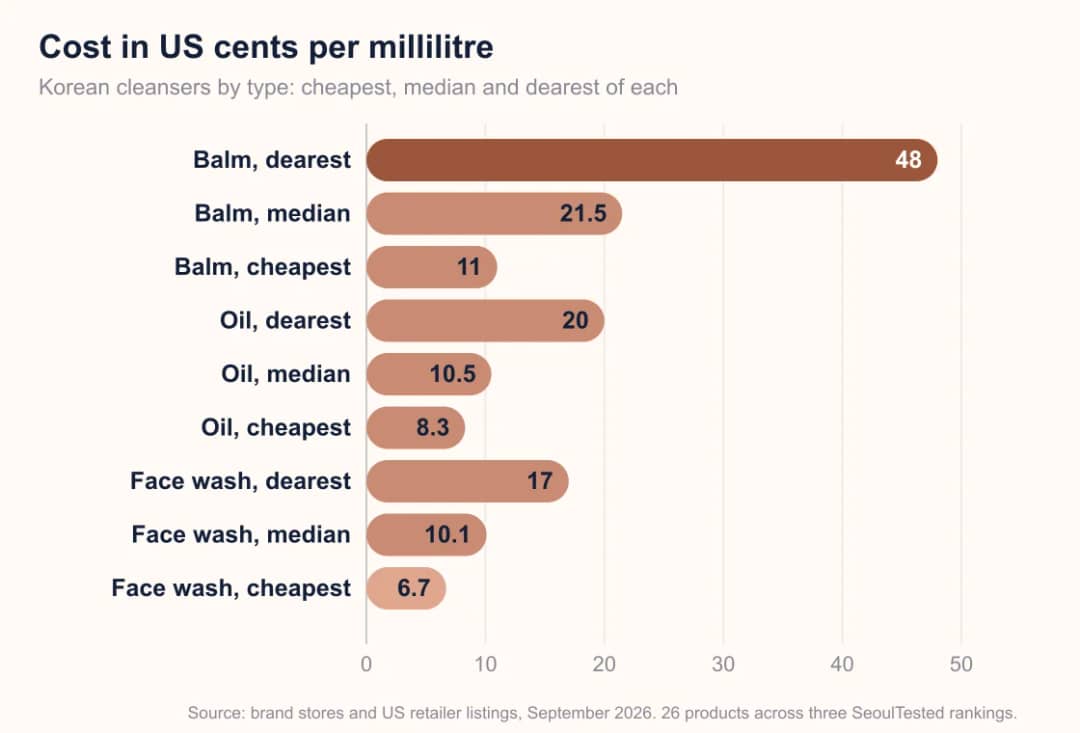
A double cleanse means buying two products instead of one, so comparing by the millilitre is fairer than comparing sticker prices. We did that across all 26 cleansers in our three rankings.
| Cleanser type | Cheapest | Median | Dearest | Products priced |
|---|---|---|---|---|
| Cleansing balm | 11c | 21.5c | 48c | 8 |
| Cleansing oil | 8.3c | 10.5c | 20c | 9 |
| Face wash | 6.7c | 10.1c | 17c | 9 |
The first cleanse is not automatically the expensive one. A cleansing oil costs a median of 10.5 cents per millilitre, level with the 10.1 cents of a face wash, so adding an oil step roughly doubles your cleansing spend and no more.
Balms sit well above both. At a median of 21.5 cents they cost more than twice a face wash, and the dearest balm we priced runs 7.2 times the cheapest face wash.
The cheapest pair in our three rankings is a cleansing oil at 8.3 cents a millilitre with a face wash at 6.7. Those figures are per millilitre and not per wash, and how much product a wash uses varies enough between people that we are not going to put a number on it.
Are cleansing balms worth the extra cost?
The complaint that double cleansing is an expensive habit is usually a complaint about balms rather than about the method. Switching the first step to an oil removes most of the cost and keeps the step.
Nothing in the research suggests balms clean better. The study tested a cleansing oil, and the case for balms is convenience: they are solid, so they do not leak in a bag, and they are easier to control on the face.
Whether that convenience is worth paying twice as much per millilitre is a judgement about your own habits, not a skincare question. The dearest balm we priced, at 48 cents, costs more than five and a half times the cheapest oil.
Which products do you actually need?
Two. One oil based product for the first step and one water based product for the second. Everything else in our cleanser coverage is a variation on those two jobs.
For the first step, the choice between formats comes down to texture and travel. Balms are solid, spill proof and pricier by volume. Oils are cheaper by volume and faster to work with.
Our rankings cover both: nine Korean cleansing oils priced from 8.3 cents a millilitre and eight cleansing balms, of which only three are genuinely unscented.
For the second step, a gentle water based wash is enough. The research above suggests the second product does not need to be clever, because the oil has already done the difficult part. Our nine Korean face washes start at 6.7 cents a millilitre.
Does using two cleansers double the fragrance?
In practice it often does, and the ingredient lists show it more clearly than the marketing does. Fragrance is common across this whole category, so using two products instead of one usually means two exposures in one sitting rather than one.
Of the eight cleansing balms we priced, only three are genuinely unscented. Of the nine face washes, four carry scent ingredients, and only one of those four declares fragrance on the front of the pack. The rest list it as a botanical oil in the INCI instead.
That is worth checking before you buy the pair rather than after. Both rankings mark which products are unscented, and pairing two fragrance-free products costs no more than pairing two scented ones.
Who should avoid double cleansing?
If your skin is dry or sensitive, or you have a condition such as eczema or rosacea, a second cleanse is the wrong place to start. Dr Wu’s warning about over washing applies here first, because a compromised barrier reacts to cleansing before it reacts to anything else.
The National Rosacea Society recommends twice daily cleansing, says non soap cleansers with a near neutral pH may be the best option, and advises avoiding abrasive cloths, exfoliating cleansers and sponges, along with ingredients including sodium lauryl sulfate, alcohol, witch hazel, fragrance and menthol (National Rosacea Society, Facial Cleansing for Rosacea).
That source sets out gentle cleansing guidance for rosacea and does not name double cleansing, so read it as a caution about cleansing intensity rather than a ruling on this method.
In practice: if you wear water-resistant sunscreen or long wear makeup, the oil step is doing measurable work. If you wear ordinary sunscreen and no makeup, the research says one gentle wash already gets you to effectively clean skin.
Where the Korean double cleanse comes from
The two step method is strongly associated with Korean and Japanese routines, and that is how it reached most people in the United States. Cleansing oils and balms have been a standard first step in Korean routines far longer than they have been shelf staples elsewhere.
Several popular articles date the practice to a specific century. We could not verify those claims against a primary historical source, so we are not repeating a date. The connection to Korean and Japanese routines is well documented. The timeline circulating online is not.
For the step in context rather than on its own, our guide to the Korean skincare routine shows where cleansing sits in the full sequence and which steps most people drop.
Frequently asked questions
Is it okay to double cleanse every day?
Once a day, at night, is the normal pattern and fits the AAD advice to limit washing to twice daily plus after sweating. Doing it morning and night is where over washing starts, and Cleveland Clinic links over washing to dryness, irritation and barrier breakdown.
Should you double cleanse in the morning or at night?
At night. The method exists to remove sunscreen, makeup and a day of sebum, none of which are on your face when you wake up. A single gentle wash, or plain water, is the usual morning recommendation.
Do you need to double cleanse if you only wear sunscreen?
It depends on the sunscreen. On water-resistant formulas a foaming cleanser left 36.8% behind in the 2020 study, against 5.8% for a cleansing oil. On ordinary sunscreen the foaming cleanser left 15.6%, no different from clean skin. Sunscreen sticks are built to resist water, so they sit in the first group.
What do dermatologists think of double cleansing?
Cleveland Clinic’s Dr Jane Wu calls it “usually not necessary” for most people, while naming waterproof makeup, sunscreen and oily skin as the cases where it helps. The broader dermatological concern is over washing rather than under washing.
What two cleansers should you not mix?
Avoid stacking two actives. A cleansing oil followed by a face wash containing salicylic acid or a scrub is two exfoliating events in one sitting. The National Rosacea Society advises against exfoliating cleansers entirely for reactive skin.
Is a cleansing balm or a cleansing oil better for the first step?
Neither performs a different job, so cost and texture decide. Across the 26 cleansers we priced, balms ran a median of 21.5 cents per millilitre against 10.5 for oils. Balms travel better, oils are cheaper per use.
What is the best way to double cleanse?
Match the first step to what you are removing. Water-resistant sunscreen or long wear makeup needs an oil based product, since a foaming cleanser left 36.8% behind in the 2020 study. For ordinary sunscreen one gentle wash is enough.
Can you use micellar water instead of an oil cleanser?
People do, and it works on a similar principle of lifting oil soluble residue. We cannot tell you how it compares on water-resistant sunscreen, because the 2020 study tested water, a foaming cleanser and a cleansing oil only. Micellar water was not measured.
The bottom line
The research points at people wearing water-resistant sunscreen or long wear makeup, and at oily skin. For everyone else the measured advantage over one thorough gentle wash is small enough that Cleveland Clinic calls the step unnecessary.
If you are in the group it helps, choosing an oil rather than a balm removes most of the cost objection. Ten and a half cents a millilitre against ten point one is not a meaningful difference in a skincare budget.
If your skin is dry, sensitive, or prone to eczema or rosacea, the question worth asking first is whether you are already washing more than your barrier wants.
Sources
- Chen W, He M, Xie L, Li L, “The optimal cleansing method for the removal of sunscreen: Water, cleanser or cleansing oil?”, Journal of Cosmetic Dermatology, 2020, volume 19, issue 1, pages 180 to 184. First published 3 June 2019. Retrieved 18 September 2026. doi.org/10.1111/jocd.12995
- Cleveland Clinic, “Double Cleansing Method Explained: Should You Try It?”, published 21 June 2022, quoting dermatologist Dr Jane Wu. Retrieved 18 September 2026. health.clevelandclinic.org
- American Academy of Dermatology Association, “Face washing 101”. No publication date shown on the page. Retrieved 18 September 2026. aad.org
- National Rosacea Society, “Facial Cleansing for Rosacea”. No publication date shown on the page. Retrieved 18 September 2026. rosacea.org
- SeoulTested price data, 26 Korean cleansers collected from brand stores and US retailer listings, September 2026, published in our cleansing oil, cleansing balm and face wash rankings, each linked above.